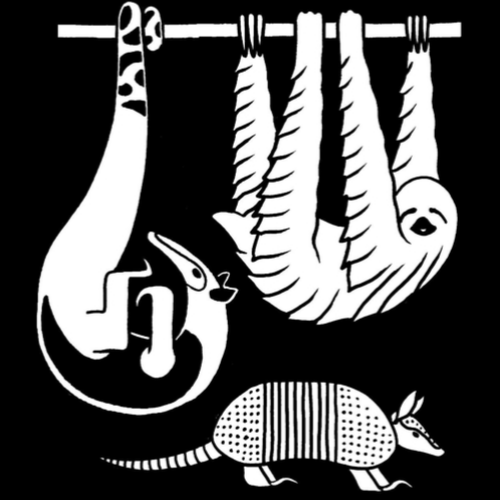
Guianan long-nosed armadillo
(Dasypus guianensis)
other common names
Guianan nine-banded armadillo
Taxonomy
Order: Cingulata
Family: Dasypodidae
Subfamily: Dasypodinae

description
The Guianan long-nosed armadillo has a head-body length of 40–50 cm, a tail of 34–46 cm length, and ears that are 4–5 cm long. It weighs 5–6 kg.

range
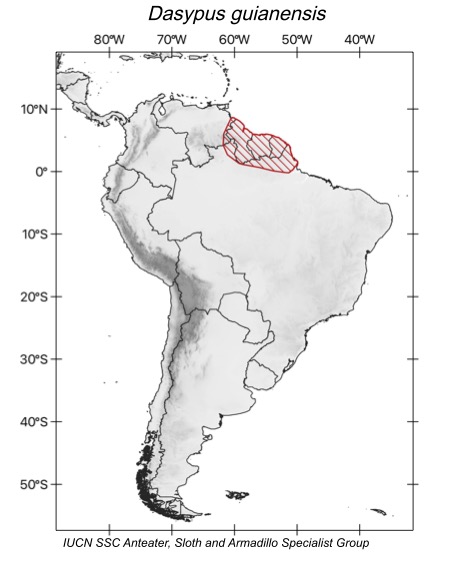
This armadillo is distributed in the Guiana Shield region, extending from the north of the lower Amazon and east of the Rio Negro rivers in northern Brazil to French Guiana, Suriname, Guyana, and east of the Orinoco river in Venezuela, where it probably overlaps with Dasypus novemcinctus. The species occurs from sea level to 450 m.

HaBITAT and ECOLOGy
This armadillo is present in primary lowland rainforest, in secondary growth, and moist savanna. It also occurs in modified habitats, such as rural gardens and urban areas. Its activity is mainly crepuscular and nocturnal. The Guianan long-nosed armadillo is a common species. In protected areas of French Guiana, population density ranges from 7–48 individuals/km2.

reproduction
It is suspected that its reproduction is similar to a closely related species, Dasypus mexicanus, which reaches sexual maturity at 12-18 months and has a gestation time of 140 days, after which it commonly produces genetically identical quadruplets.

diet
This is a generalist insectivore that also feeds on a wide variety of other items, such as fruits and worms.

curious facts
The Guianan long-nosed armadillo has only recently been described as a separate species. Nine-banded armadillos in the Guiana Shield were long thought to belong to the widespread species Dasypus novemcinctus, but molecular and morphological analyses provided evidence that they are a separate species. The Guiana Shield is well-known for its high number of endemic species (i.e., those that only occur within its borders), particularly plants and amphibians. About 11% of the mammals living in this area are endemic.

threats
There are no major threats to this species; it is hunted throughout its range, but given its high rate of reproduction it seems able to withstand a reasonably high degree of offtake.

Population trend
Stable.

conservation status
Dasypus guianensis is listed as Least Concern in view of its presumed large population, tolerance of habitat alteration, and because there is no evidence of a major population decline.