
Mexican long-nosed armadillo
(Dasypus mexicanus)
other common names
Common long-nosed armadillo
Nine-banded armadillo
Taxonomy
Order: Cingulata
Family: Dasypodidae
Subfamily: Dasypodinae

description
The Mexican long-nosed armadillo has a head-body length of 38–45 cm, a tail of 30–43 cm, and ears that are 3.5–4.3 cm long. It weighs 3–6 kg. It can have 7–11 bands but the most common number of bands is 9. The carapace often contains areas of tan or pale yellow on the sides of the body.

range
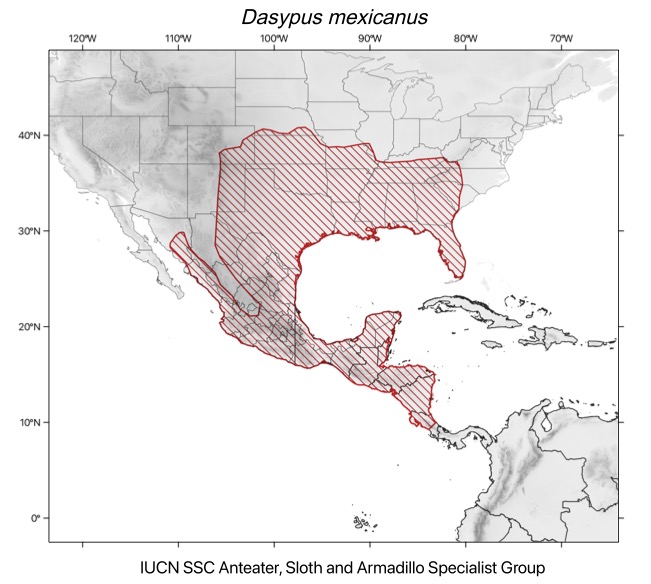
This armadillo ranges from central-eastern United States of America to Costa Rica, where its range probably overlaps with that of Dasypus fenestratus. It occurs from sea level to almost 2500 m. Its range is expanding in the United States.

HaBITAT and ECOLOGy
This armadillo is most commonly found in primary, undisturbed hardwood forest in riparian areas, but it is very adaptable and present in a variety of habitats.
The nine-banded armadillo is a common species. Its home range most commonly averages 6–10 hectares, but it can be as small as 0.5 and up to 20 hectares. Adults are solitary and rarely interact except during the breeding season, but juvenile littermates often forage together during their first summer. In the US they are mainly active at night, but this can vary seasonally, with individuals being more active in the afternoon during colder times of the year.

reproduction
In the USA, this species has a high rate of reproduction and breeds in early summer. After mating, implantation is delayed until mid- to late autumn, or even longer under stressful situations. There are reports of laboratory or zoo-housed females that gave birth 2–3 years after mating. Upon implantation, the fertilized egg splits to create four genetically identical embryos, a phenomenon called polyembryony. The offspring are born in spring, after a gestation of 120–130 days, and are nursed inside the burrow for approximately 6 weeks.

diet
This is a generalist insectivore that primarily eats beetles (adults and larvae), ants, and termites. However, it can also feed on a wide variety of other items, such as small vertebrates, fruits, worms, bird eggs, and turtle eggs.

curious facts
Mexican long-nosed armadillos were first reported in the United States in 1849 and became the official State Small Mammal of Texas in 1995. The reasons given in the House Concurrent Resolution is that it “is a hardy, pioneering creature that chose to begin migrating here at about the time that Texas became a state”, and it “possesses many remarkable and unique traits, some of which parallel the attributes that distinguish a true Texan, such as a deep respect and need for the land, the ability to change and adapt, and a fierce undying love for freedom”.

threats
There are no major threats to this species; it is hunted throughout its range, but given its high rate of reproduction it seems able to withstand a reasonably high degree of offtake. It is also commonly killed by vehicles on roads / highways. In the USA, it is subject to culling as it is often considered a nuisance.

Population trend
Stable.

conservation status
Dasypus mexicanus is listed as Least Concern in view of its wide distribution, presumed large population, tolerance of habitat alteration, and because there is no evidence of a major population decline.