
Western Andean long-nosed armadillo
(Dasypus fenestratus)
other common names
Western Andean nine-banded armadillo
Taxonomy
Order: Cingulata
Family: Dasypodidae
Subfamily: Dasypodinae

description
The western Andean long-nosed armadillo has a head-body length of 38–50 cm, a tail of 26–35 cm, and ears that are 4–5 cm long. It weighs 2–4 kg. The carapace often contains areas of tan or pale yellow on the sides of the body.

range
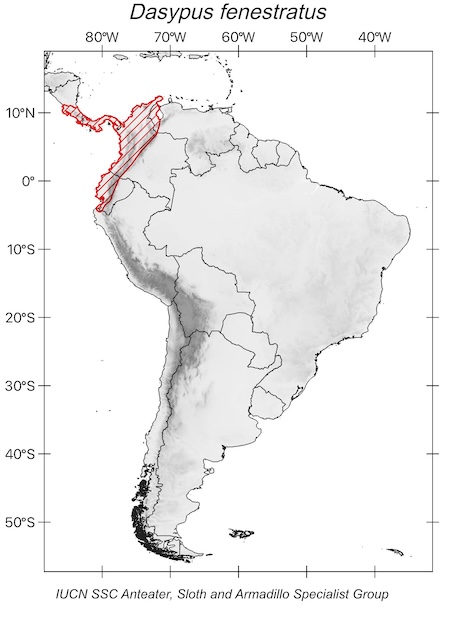
This armadillo is distributed from the western slopes of the Andes in northern Peru, Ecuador, Colombia, and Venezuela to Costa Rica, where its range probably overlaps with that of Dasypus mexicanus. It occurs from sea level to 3100 m.

HaBITAT and ECOLOGy
This armadillo is present in a variety of ecosystems and is very tolerant to habitat alteration.
The Western Andean long-nosed armadillo is a common species. It is mainly crepuscular and nocturnal.

reproduction
It is suspected that the natural history features are similar to those of its sister species Dasypus mexicanus, which reaches sexual maturity at 12-18 months, has a gestation time of 140 days, and always gives birth to four monozygotic (genetically identical) offspring per litter.

diet
This is a generalist insectivore that also feeds on a wide variety of other items, such as small vertebrates, fruits, worms, bird eggs, and turtle eggs.

curious facts
In Latin, fenestratus means “having one or more windows”. But what does the scientific name of this species have to do with a window? In his original description of the species, Peters (1865) mentions that its name refers to the shape of the scales of the rear rows of bands, which look like Gothic windows.

threats
There are no major threats to this species; it is hunted throughout its range, but given its high rate of reproduction it seems able to withstand a reasonably high degree of offtake.

Population trend
Stable.

conservation status
Dasypus fenestratus is listed as Least Concern in view of its presumed large population, tolerance of habitat alteration, and because there is no evidence of a major population decline.