Seven-banded armadillo
(Dasypus septemcinctus)
other common names
Lesser long-nosed armadillo
Taxonomy
Order: Cingulata
Family: Dasypodidae
Subfamily: Dasypodinae

description
The seven-banded armadillo has a head and body length of 24–47 cm, a tail length of 13–20 cm, a slender head, and ears measuring 2–3.5 cm. Its carapace usually has 6–7 movable bands, but sometimes there is an eighth band. It weighs around 2 kg. Currently, two morphological types or subspecies are recognized that have clear differences: D. septemcinctus septemcinctus, which is smaller (adults do not exceed 1.2 kg) and has proportionally larger ears than D. septemcinctus hybridus (adults exceed 1.5 kg). In addition, there is a third type or subspecies, D. s. cordobensis, which is only known from the type material deposited in the Museo Argentino de Ciencias Naturales Bernardino Rivadavia, Argentina.

range
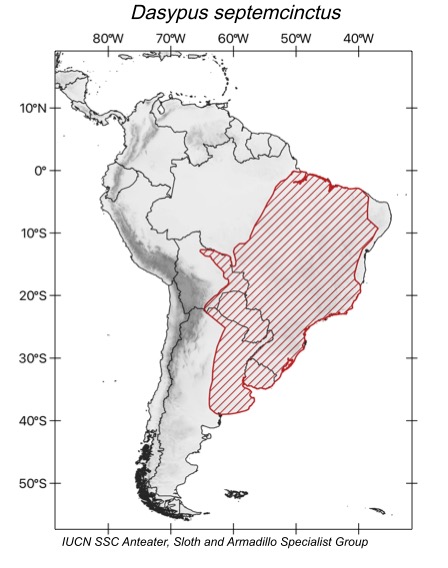
Dasypus septemcinctus is distributed in Brazil, Paraguay, Bolivia, Argentina, and Uruguay. It can be found from sea level to 2,000 m above sea level. Its southern limit of occurrence is in the province of Buenos Aires (Argentina).
D. s. septemcinctus can be found in Brazil, eastern Paraguay, eastern Bolivia, and a small region in northern Argentina. Dasypus s. hybridus is present in southern Brazil, Uruguay, and eastern, central, and northern Argentina. D. s. cordobensisis only known from its type locality: “Córdoba, Argentina.”

HaBITAT and ECOLOGy
Dasypus s. hybridus is diurnal, whereas D. s. septemcinctus seems to be nocturnal. The species is typically found in open areas, although it is also present in forests, shrublands and forested areas. It tends to be less common in modified environments such as agroecosystems, especially in areas of intensive agriculture. It was previously more common and abundant (although no population density estimates are available), but as it is a species sensitive to habitat loss, mainly caused by urbanization and agricultural expansion, populations are declining or have disappeared in several locations within its historical range. However, it remains a common species in some parts of its range, such as various livestock regions in the province of Buenos Aires.

curious facts
Its Spanish name, “mulita” (= little mule), refers to its proportionally large ears, similar to those of mules. It is one of the few species of mammals that, with only four teats, often has 6 to 12 offspring.

reproduction
The breeding season seems to begin in March, and the young are born between October and December, after a diapause period of about 120 days. This armadillo species has 4 to 12 young per litter, which are born in underground burrows. 4-8 (rarely 12) young have been reported for D. s. septemcinctus, and 6-12 young per litter for D. s. hybridus.

diet
This armadillo is classified as an opportunistic or generalist insectivore, although some authors consider it omnivorous with a strong preference for ants and termites. In addition to ants, termites, and beetles, it eats plant material and, sometimes, small vertebrates such as mice, amphibians, and reptiles.

threats
Dasypus septemcinctus is threatened by habitat loss due to agriculture and urbanization, accidental mortality on roads, direct hunting for food, and predation by dogs (domestic and feral).

Population trend
Stable.

conservation status
Dasypus septemcinctus is listed as Least Concern (LC) due to its wide distribution, its presumed large population, its presence in several protected areas, and because its decline is unlikely to be rapid enough to warrant inclusion in the threatened category. However, in much of its range, these armadillos face hunting pressure, frequent vehicle collisions, and significant habitat disturbance.