Greater long-nosed armadillo
(Dasypus kappleri)
other common names
Kappler’s armadillo
Taxonomy
Order: Cingulata
Family: Dasypodidae
Subfamily: Dasypodinae

description
Until recently, Dasypus kappleri was a single species. Recent morphological, morphometric, and molecular analyses suggest that the former “D. kappleri” represents a species complex containing D. kappleri, D. pastasae, and D. beniensis.
Only exceeded in size by the giant armadillo (Priodontes maximus), the greater long-nosed armadillo has a head-body length of 51–58 cm and a tail length of 33–48 cm, and its carapace has 7–8 movable bands. It weighs around 8.5–10.5 kg. Apart from its size, it can be distinguished from other armadillos of the genus Dasypus based on the enlarged projecting scales at the knee; a wide base of the tail; and a lighter skin color on the part of the head that is not covered by the cephalic shield.
Apparently, D. kappleri can be distinguished from D. pastasae and D. beniensis by its unique pattern of smooth, flattened, and uniform scales on the pelvic shield, with the central and peripheral scales at the same levels, and by keeled scales on the proximal tail rings.

range
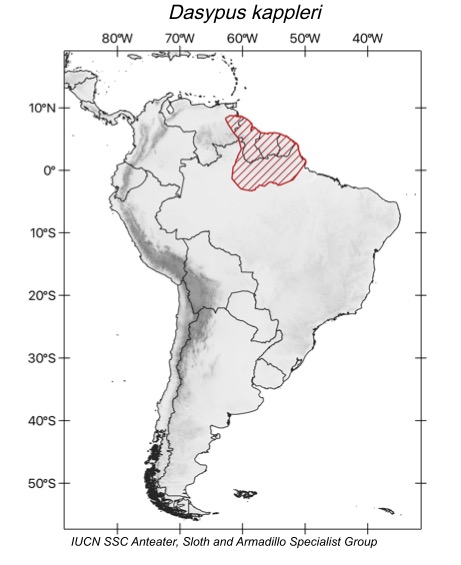
Dasypus kappleri occurs in the Guiana Shield, i.e., in French Guiana, Suriname, Guyana, eastern Venezuela, and parts of northern Brazil. In Brazil it is found east of the Rio Negro-Rio Branco and north of the lower Amazon River.

HaBITAT and ECOLOGy
Dasypus kappleri is restricted to lowland tropical rainforest. It has nocturnal habits, and is probably solitary and asocial.

diet
It is probably a generalist insectivore.

reproduction
Not much is known about the reproduction of greater long-nosed armadillos. Two offspring are born per litter. Anecdotal evidence suggests that they are always of the same sex, but it remains to be studied whether they are the result of polyembryony, as occurs in other species of the genus Dasypus.

curious facts
Some researchers consider that Dasypus kappleri, D. beniensis and D. pastasae are distinct enough to warrant separation in a separate genus, Hyperoambon.

threats
There are no major threats to this armadillo. Locally, the species may be threatened by deforestation and hunting. Deforestation for agricultural expansion has affected large areas of the species’ habitat, which is a cause of concern because it is unable to survive in savannas or open areas.

Population trend
Unknown.

conservation status
Dasypus kappleri is listed as Least Concern in view of its distribution in areas facing limited habitat loss, its occurrence in several protected areas, and because it is unlikely to be declining fast enough to qualify for listing in a threatened category.