Greater long-nosed armadillo
(Dasypus beniensis)
other common names
–
Taxonomy
Order: Cingulata
Family: Dasypodidae
Subfamily: Dasypodinae

description
Until recently, Dasypus kappleri was a single species. Recent morphological, morphometric, and molecular analyses suggest that the former “D. kappleri” represents a species complex containing D. kappleri, D. pastasae, and D. beniensis.
Only exceeded in size by the giant armadillo (Priodontes maximus), D. beniensis has a head-body length of 51–58 cm and a tail length of 33–48 cm, and its carapace has 7–8 movable bands. It probably weighs around 8.5–10.5 kg, but it has been described as being the largest of the three species in the “Dasypus kappleri” complex. Apart from its size, it can be distinguished from other armadillos of the genus Dasypus based on the enlarged projecting scales at the knee; a wide base of the tail; and a lighter skin color on the part of the head that is not covered by the cephalic shield.
Morphologically similar to D. pastasae, this species apparently has rough scales on the pelvic shield and flattened scales in the proximal rings of the tail. In addition, the species has characteristic skull features that can only be observed in museum specimens but not in live animals.

range
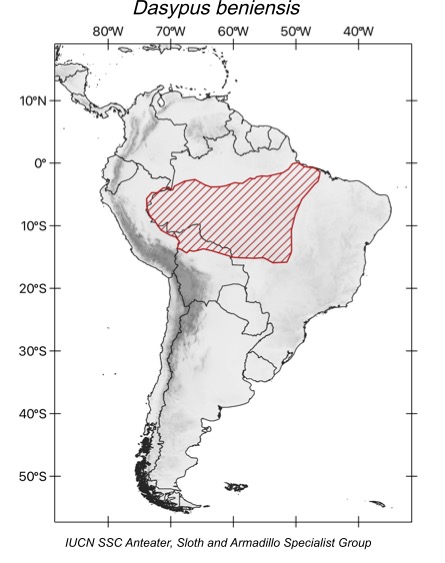
Dasypus beniensis can be found on the right bank of the lower Amazon and Madeira rivers in Brazil and the right bank of the Madre de Dios River in Bolivia. There are several records of the species along the northern border of Bolivia (in Madidi National Park), near Peru, suggesting that it likely also occurs in adjacent regions of Peru. Therefore, further studies are needed to confirm its presence in that area. Its southern limits are probably the dry forests and savannas of the Llanos de Moxos in Beni, Bolivia and the Caatinga and Cerrado of Brazil.

HaBITAT and ECOLOGy
Dasypus beniensis is restricted to lowland tropical rainforest, and ecotones with savannas. It has nocturnal habits, and is probably solitary and asocial. A population density of eight individuals per square kilometer was estimated from the Kayapó of A’Ukre indigenous reserve in the Brazilian Pará state.

diet
It is probably a generalist insectivore that feeds on arthropods and other invertebrates such as beetles, centipedes, millipedes and also earthworms.

reproduction
Not much is known about the reproduction of greater long-nosed armadillos. Two offspring are born per litter. Anecdotal evidence suggests that they are always of the same sex, but it remains to be studied whether they are the result of polyembryony, as occurs in other species of the genus Dasypus.

curious facts
Its scientific name, beniensis, refers to the Río Beni in Bolivia, where it was first described (i.e., its type locality).

threats

Population trend
Unknown.

conservation status
Dasypus beniensis is listed as Least Concern in view of its wide distribution, its occurrence in a number of protected areas, and because it is unlikely to be declining fast enough to qualify for listing in a threatened category. It should, however, be noted that part of its distribution lies in the Arc of Deforestation, where its habitat is rapidly declining.