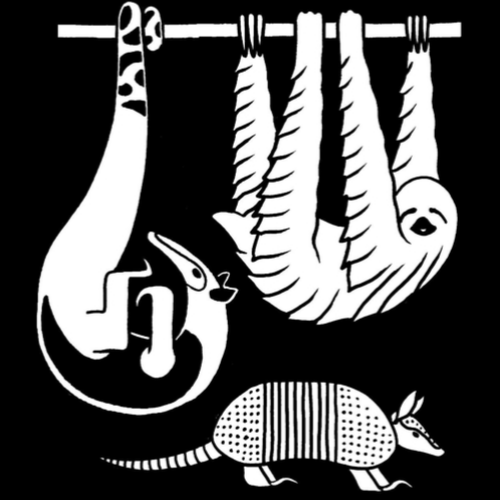
Southern nine-banded armadillo
(Dasypus novemcinctus)
other common names
Southern long-nosed armadillo
Taxonomy
Order: Cingulata
Family: Dasypodidae
Subfamily: Dasypodinae

description
The southern nine-banded armadillo has a head-body length of 28–50 cm, a tail of 12–45 cm length, and ears that are 2–5 cm long. It weighs 3–6 kg. In spite of its common name, it can have 7–11 bands but the most common number of bands is 9. The carapace often contains areas of tan or pale yellow on the sides of the body.

range
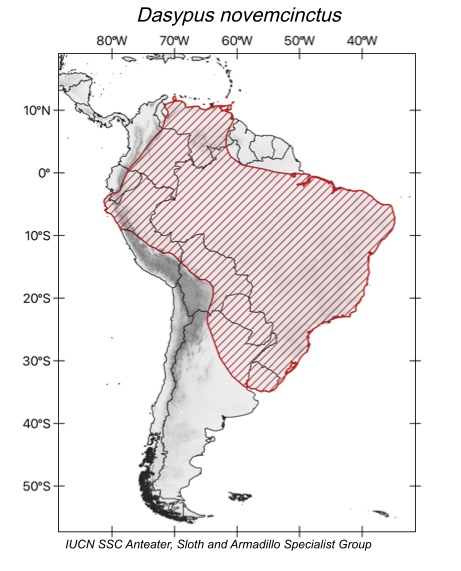
This armadillo is distributed from the eastern slopes of the Andes from Ecuador, Colombia, and Venezuela to Brazil, Peru, Bolivia, Paraguay, Uruguay, and northern Argentina. It is also present in Trinidad and Tobago. This species is absent in the Guiana Shield, except in the peripheral zone of eastern Venezuela, where it may occur in sympatry with Dasypus guianensis. This species occurs from sea level to 2300 m.

HaBITAT and ECOLOGy
This armadillo is present in a variety of primary habitats and disturbed landscapes. Nine-banded armadillos are mainly nocturnal.
The nine-banded armadillo is a common species. Adults are solitary and rarely interact except during the breeding season, but juvenile littermates often forage together during their first summer.

reproduction
Females give birth to one litter per year, which consists of four monozygotic (genetically identical) offspring. This species exhibits strongly marked seasonality in reproduction, and a gestation of 140 days.

diet
This is an omnivore-insectivore that primarily eats beetles (adults and larvae), ants, and termites. However, it can also feed on a wide variety of other items, such as scorpions, millipedes, small vertebrates, and fruits.

curious facts
Although its common name suggests that this species always has nine bands, the carapace of a nine-banded armadillo can actually have 7 to 11 bands – but nine is the most common number of bands.

threats
There are no major threats to this species; it is hunted throughout its range, but given its high rate of reproduction it seems able to withstand a reasonably high degree of offtake.

Population trend
Stable.

conservation status
Dasypus novemcinctus is listed as Least Concern in view of its very wide distribution, presumed large population, tolerance of habitat alteration, and because there is no evidence of a major population decline.