
Pink fairy armadillo
(Chlamyphorus truncatus)
other common names
Lesser fairy armadillo
Pichiciego
Taxonomy
Order: Cingulata
Family: Chlamyphoridae
Subfamily: Chlamyphorinae

description
This is the smallest of all armadillos. It measures about 11 to 15 cm from the head to the base of the tail and weighs around 100 grams. Its carapace is pinkish and only attached to the body by a thin membrane along the dorsal midline, but free of the body along the sides.
White, silky hair cover the ventral and lateral parts of the body, extending under the carapace. Another unusual feature of the pink fairy armadillo is its rounded, vertical rump plate.
The digging claws are enlarged, because of which it walks on the tips of the front claws. The tip of the tail is diamond-shaped, and the ears are not visible.

diet
It is probably a generalist insectivore that mainly feeds on invertebrates such as beetles, ants, insect eggs and larvae, worms and snails. It possibly also ingests some plant material.

range
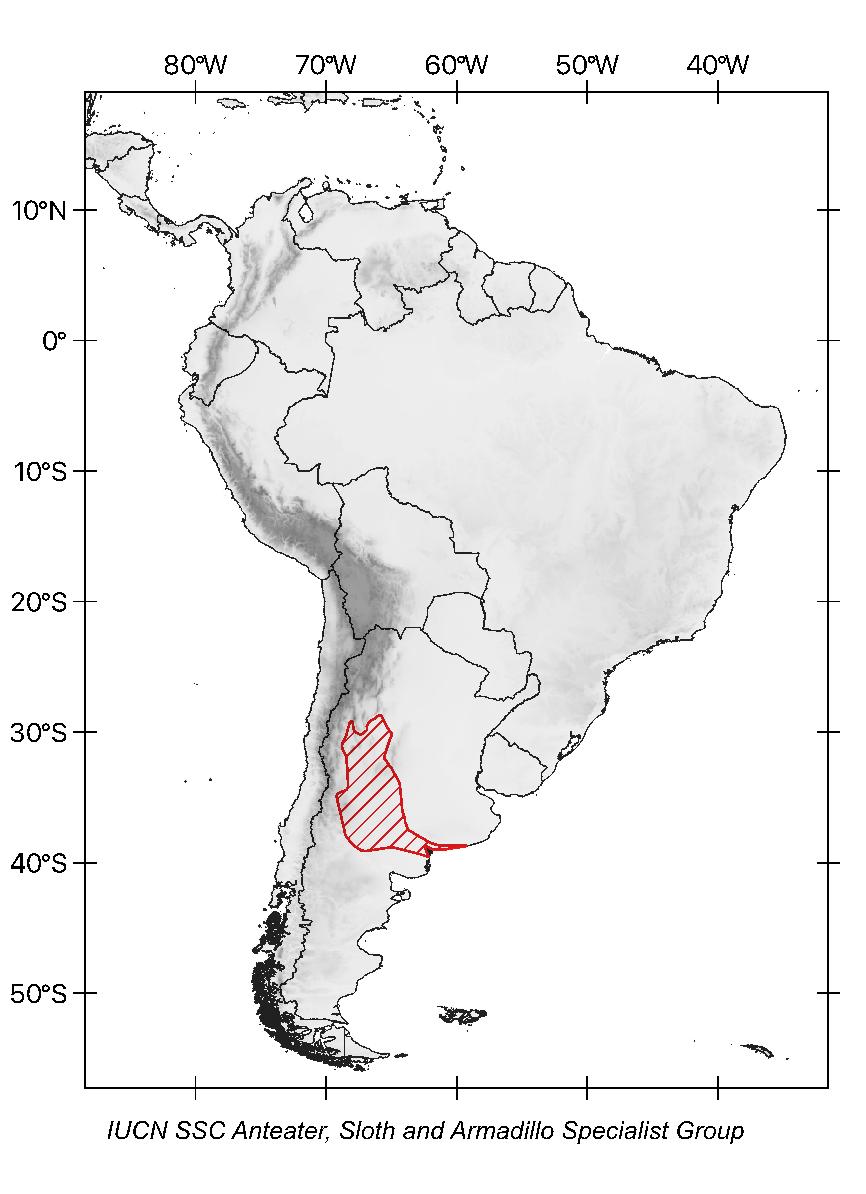
This species is endemic to Argentina, where it occurs from southern Catamarca to northern Río Negro and Southeastern Buenos Aires provinces.

Population trend
Unknown.

curious facts
The pink fairy armadillo uses its vertical rump plate to backfill the tunnels it digs.

threats
Habitat conversion due to agriculture (plowing of fields) and cattle ranching (compaction of soil) are thought to be threatening this species, but predation by domestic cats and dogs may also contribute to its decline. Furthermore, the species is illegally collected to be kept as a pet or with the intention to sell it on the black market, but the large majority of specimens removed from the wild die within eight days. Global climate change may also affect the species, as past climate variations probably caused its current low densities due to fluctuations in the amount of suitable habitat.

HaBITAT and ECOLOGy
This poorly known, nocturnal species is found in dry grassland and sandy plains with shrubby vegetation, always on sandy soils. It has subterranean habits and emerges only occasionally. No information is available about its home range, population size or density. It may be relatively rare, as records are very isolated from each other.

reproduction
Not much is known about the reproduction of this species. It probably gives birth to one or two offspring in spring or early summer.

conservation status
The pink fairy armadillo is listed as Data Deficient because there is little information on the population status of this species, and its biology and ecology are poorly known. Throughout its range there is extensive habitat degradation, especially from cattle and goat ranching, but the actual effect on the population is not well understood. Collection of individuals to keep them as pets or sell them on the black market are increasingly threatening the species, as it does not survive in captivity. The species remains a priority for further survey work, as the availability of additional information may well show that the species requires listing as Near Threatened or in a threatened category.